
Top Ways on How Should Banks Handle Secure IT Asset Disposal
Table of Contents
- Why Secure IT Asset Disposal Is a Non-Negotiable for Banks
- The Real Cost of Getting IT Disposal Wrong
- What Assets Do Banks Need to Dispose Of?
- The Regulatory Framework Banks Must Follow
- Step-byStep: How Banks Should Handle Secure IT Asset Disposal
- Understanding Data Sanitization Methods
- Why the Certificate of Destruction Is Non-Negotiable
- Choosing a Certified ITAD Vendor
- The Environmental Side of Bank IT Disposal
- Frequently Asked Questions
Why Secure IT Asset Disposal Is a Non-Negotiable for Banks
Every day, a bank's servers, laptops, ATM systems, point-of-sale terminals, and networking hardware process and store some of the most sensitive personal and financial data in existence. We are talking about Social Security numbers, account credentials, transaction histories, loan records, and consumer credit profiles.
When that hardware reaches the end of its life, it becomes a liability, a data risk hiding in plain sight, unless it is decommissioned through a structured, compliant, and certified process.
This is what secure IT asset disposal means for the banking sector. It is a formal, documented, and verifiable method of retiring technology in a way that permanently eliminates data risk, satisfies legal and regulatory obligations, and responsibly manages the resulting electronic waste.
Banks that treat IT disposal as an afterthought face consequences that are severe, public, and expensive. Those that treat it as a core compliance function protect their customers, their reputation, and their bottom line.
The Real Cost of Getting IT Disposal Wrong
The financial sector consistently ranks among the most targeted industries for data breaches, and a significant percentage of those breaches originate from improperly disposed hardware.
According to IBM's Cost of a Data Breach Report, the average data breach cost for financial services organisations reached $6.08 million per incident in 2024, making it the second most expensive sector after healthcare. A 2024 study by Blancco Technology Group found that 42% of used hard drives purchased online contained recoverable personal and corporate data, pointing directly at the gaps in how businesses retire their electronic devices.
The Verizon 2024 Data Breach Investigations Report confirmed that human error, including the failure to properly dispose of IT assets, contributes to 28% of all confirmed breaches. Meanwhile, the UN's 2024 Global E-Waste Monitor reported that 62 million metric tonnes of e-waste entered disposal systems in 2022 alone, with only 22.3% receiving proper handling.
For banks specifically, the consequences extend far beyond the breach itself. Non-compliance with data protection regulations can trigger fines reaching $500,000 per incident under PCI DSS, along with loss of payment processing privileges, class-action lawsuits, and reputational damage that takes years to repair. The Morgan Stanley case is a cautionary landmark: the U.S. Office of the Comptroller of the Currency fined the bank $60 million after a third-party ITAD vendor failed to properly wipe SSDs and other hardware, allowing devices containing unencrypted client data to be sold on the open market.
The lesson is clear: improper IT asset disposal is a legal, financial, and reputational crisis waiting to unfold.
What Assets Do Banks Need to Dispose Of?
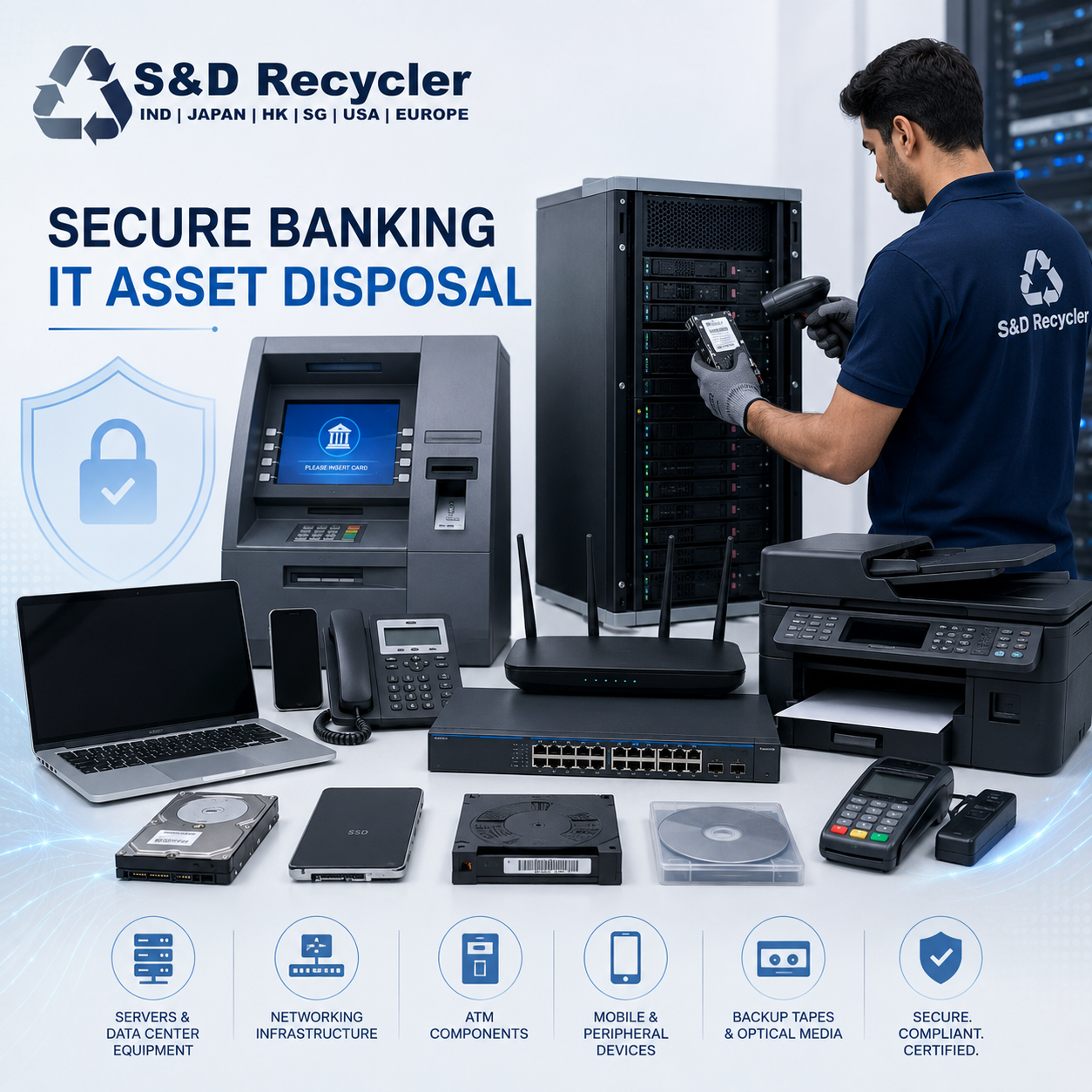
Banks operate large, complex technology environments that are refreshed on regular cycles. The scope of assets requiring secure disposal is broader than most industries realise:
- Computing Hardware: Desktops, laptops, tablets, and workstations used by branch staff, back-office teams, and remote employees.
- Servers and Data Center Equipment: On-premises servers, blade systems, rack units, storage area networks (SANs), and network-attached storage (NAS) devices that hold core banking data, customer records, and transaction logs.
- Networking Infrastructure: Routers, switches, firewalls, and load balancers that may store configuration data, routing tables, and access credentials in onboard memory.
- ATM Components: ATM hard drives and storage modules frequently contain transaction logs and partial customer account data that must be sanitized before any part is replaced or retired.
- Mobile and Peripheral Devices: Smartphones, tablets, point-of-sale terminals, card readers, printers with internal hard drives, and copiers, all of which can retain sensitive data in embedded storage.
- Backup Tapes and Optical Media: Legacy backup systems, magnetic tapes, and optical discs used for archival storage across decades of operations.
The Regulatory Framework Banks Must Follow
Regulatory compliance is the foundation of any bank's IT asset disposal program. Banks do not have the option to choose their own standards based on convenience. Multiple overlapping regulations mandate specific practices, and failing any one of them creates serious exposure.
Gramm-Leach-Bliley Act (GLBA)
The Gramm-Leach-Bliley Act is the regulation for financial institution data privacy. The GLBA's Safeguards Rule requires financial institutions to develop, implement, and maintain a comprehensive security program to protect customer information. Critically, this includes specific requirements for the secure disposal of non-public personal information (NPII) before any electronics are recycled, refurbished, or resold.
The FTC's updated Safeguards Rule, which went into effect with strengthened provisions in 2023, adds further requirements. Financial institutions must now implement documented policies for information disposal, regularly review those procedures, and conduct vulnerability assessments and annual penetration tests. The Rule explicitly states that businesses must take "reasonable measures to protect against unauthorised access" to customer information during disposal.
Payment Card Industry Data Security Standard (PCI DSS)
PCI DSS v4.0.1, effective from March 31, 2025, raises the bar significantly for banks and payment processors. It mandates that cardholder data and sensitive authentication data be destroyed using unrecoverable methods such as shredding or incineration. Banks are now required to conduct quarterly verifications to confirm that no unnecessary cardholder data remains on storage systems, and all destruction must be documented with auditable certificates. Non-compliance carries penalties of up to $500,000 per incident, increased audit scrutiny, and the potential loss of payment processing privileges.
Federal Financial Institutions Examination Council (FFIEC)
The FFIEC provides guidelines that sit across all federally supervised financial institutions, encompassing banks, credit unions, thrift institutions, and non-bank financial companies. FFIEC guidelines require institutions to implement a comprehensive risk management program covering secure data disposal, conduct thorough due diligence on ITAD vendors, maintain detailed records of all destruction activities, and perform regular audits of their disposal processes. The FFIEC explicitly states that financial institutions cannot outsource their regulatory compliance obligations, meaning the bank remains responsible even when a third-party vendor performs the actual work.
Step-by-Step: How Banks Should Handle Secure IT Asset Disposal
A compliant IT asset disposal program for a bank is a formal, repeatable process built on documentation, accountability, and verification at every stage.
Step 1: Build a Formal IT Asset Disposal Policy
Every bank must have a written policy that governs how retiring IT assets are handled from the moment a decommission decision is made to the point of final destruction or recycling. This policy must define approved sanitization methods by asset type, specify documentation requirements, assign roles and responsibilities to data owners, IT security teams, compliance officers, and asset managers, and set timelines for asset retirement.
Step 2: Conduct a Complete Asset Inventory
Before a single device is decommissioned, it must be inventoried. By November 2025, FFIEC-aligned regulations updated by NIST's Cybersecurity Framework 2.0 now require banks to maintain a comprehensive asset inventory that tracks each device's owner, location, classification, and intended disposal procedure. Every hard drive, server, laptop, and mobile device must be catalogued with its serial number, hardware specifications, and the type of data it was used to store or process.
Step 3: Assess Data Sensitivity
Not all data is equal, and not all devices require the same level of destruction. Devices that held highly sensitive cardholder data, account credentials, or confidential customer records require Purge or Destroy-level sanitization under NIST 800-88. Devices used for general administrative functions with no customer data may be eligible for a lower-intensity Clear method, provided that determination is documented and justified.
Step 4: Sanitize Data Using Approved Methods
Data sanitization must happen before any device leaves the bank's control. This is non-negotiable. The method selected must match the sensitivity classification of the data the device held. Detailed breakdowns of approved methods are covered in the next section.
Step 5: Maintain an Unbroken Chain of Custody
Every device must be tracked from the moment it enters the disposal process to the point of final destruction or certified recycling. Chain of custody documentation must record who handled the device, when and where it was transferred, and what security controls were in place during transit. GPS-monitored transport, sealed and tamper-evident containers, and signed handover forms are all standard practices for ITAD programs serving the financial sector.
Step 6: Choose a Certified ITAD Vendor
Once devices are ready to leave the bank's premises, only a certified and vetted ITAD vendor should handle them. Vendor selection is a critical compliance step, not an administrative one. Full guidance on what to look for in a certified ITAD vendor is provided below.
Step 7: Obtain and Archive Certificates of Destruction
A Certificate of Destruction (COD) must be obtained for every single device that passes through the ITAD process. This document serves as the bank's legal proof of compliance and must be retained for audit purposes. Details on what a valid COD must contain are covered in the dedicated section below.
Step 8: Audit and Review the Program Regularly
GLBA, PCI DSS, and FFIEC all require periodic testing and monitoring of information security safeguards, including disposal practices. Banks must schedule regular audits of their ITAD program, review their vendor relationships, and update their policies when regulatory requirements change.
Understanding Data Sanitization Methods
The method of data destruction or sanitization a bank chooses is not a matter of preference. It must match the data sensitivity classification and the type of media being retired. NIST SP 800-88 defines the framework through three levels.
Clear
Clearing applies software-based overwriting to storage media. It renders data unreadable through standard means but does not protect against advanced laboratory recovery techniques. This level is appropriate only for devices being reused internally within the bank's own controlled environment, never for devices being transferred outside the organisation.
It is critical to note that a simple factory reset, file deletion, or standard format does not constitute a compliant Clear under NIST 800-88. Certified software that overwrites data across all addressable storage locations must be used.
Purge
Purging ensures that data cannot be recovered even using advanced forensic or laboratory techniques. For traditional magnetic hard drives, this involves multi-pass overwriting or degaussing. For solid-state drives (SSDs), it is important to understand that standard overwriting does not work due to the way SSDs use wear leveling. For SSDs, NIST 800-88 recommends either cryptographic erase (if the drive supports it) or physical destruction. Purge-level sanitization is appropriate when media will leave the bank's control for resale, donation, or external recycling.
Destroy
Physical destruction renders the media completely and permanently unusable. Methods include shredding (reducing the device to particles below a specified size threshold), crushing, disintegration, and incineration. Destroy is required for media that held the most sensitive data classifications, for devices in unknown or failed states, and for any media where Purge-level sanitization cannot be verified. For banks handling classified or highly sensitive customer data at scale, physical destruction is often the preferred choice precisely because it eliminates any uncertainty about residual data.
A Note on Degaussing
Degaussing applies a powerful magnetic field to erase data from magnetic media. While it was once a standard destruction method, it is important to know that degaussing has no effect on SSDs, USB drives, or any flash-based storage. As the banking sector has rapidly transitioned away from legacy magnetic HDDs toward SSD-based infrastructure, degaussing as a standalone method is increasingly insufficient and must be paired with physical destruction for modern storage media.
Why the Certificate of Destruction Is Non-Negotiable
A Certificate of Destruction (COD) is the bank's legal documentation that a specific asset was processed using a specific sanitization method, by a specific vendor, on a specific date, and that the data it contained is now permanently irrecoverable. It is the proof of compliance that regulators, auditors, and courts will look for when a bank's disposal practices are called into question.
Under PCI DSS v4.0.1, GLBA, and FFIEC guidelines, data destruction must be documented and certified. An audit without supporting CODs is an audit that cannot be defended.
A valid Certificate of Destruction must include the asset's serial number and hardware description, the sanitization method used and the NIST 800-88 classification it satisfies, the date and time of destruction, the name and certification status of the vendor who performed the destruction, and the signature of an authorised technician. Banks should store CODs in their IT asset management system and ensure they can be retrieved for any audited time period upon request.
Choosing a Certified ITAD Vendor
The selection of an ITAD vendor is a compliance decision, not a procurement decision. Banks remain legally responsible for what happens to their data even after handing assets to a vendor. Under FFIEC guidelines, financial institutions must conduct thorough due diligence before selecting a vendor, assess the vendor's security controls, certifications, and data destruction methods, and establish written agreements specifying the vendor's responsibilities.
Here is what banks must require from any ITAD partner:
- NAID AAA Certification: Issued by the National Association for Information Destruction, NAID AAA certification requires unannounced audits of the vendor's destruction processes, facilities, and employee screening. It is the gold standard for ITAD vendors serving regulated industries.
- R2 and e-Stewards Certification: These certifications govern responsible electronics recycling practices and environmental compliance. Banks partnering with R2 and e-Stewards certified vendors can demonstrate environmentally responsible disposal of e-waste, which increasingly matters for ESG reporting.
- ISO 14001 Certification: This international environmental management standard confirms that the vendor operates its recycling and destruction processes in a way that minimises environmental impact.
- ISO 27001 Certification: This standard governs information security management systems. An ITAD vendor holding ISO 27001 certification has demonstrated that it has embedded data security controls throughout its operations, including access control, incident management, and documented processes for handling client assets.
- Transparent Chain of Custody: The vendor must provide GPS-monitored transport, serialised asset tracking from pickup to destruction, and full audit trail documentation. There should never be a gap in the documented record of where a bank's devices were and who had access to them.
- On-Site Destruction Option: For the most sensitive devices, many banks require witnessed, on-site physical destruction. A qualified ITAD vendor should offer mobile destruction services that bring certified shredding or degaussing equipment directly to the bank's facility.
- Third-Party Risk Assessments: Banks must conduct regular assessments of their ITAD vendor's financial stability, security posture, and compliance record. A vendor that passes devices to an unvetted sub-contractor, as happened in the Morgan Stanley case, creates catastrophic downstream liability for the bank.
The Environmental Side of Bank IT Disposal
Secure IT asset disposal is not only a data security and compliance issue. It is also an environmental responsibility that is growing in regulatory and public significance.
The UN Global E-Waste Monitor 2024 reported that global e-waste generation has reached 62 million metric tonnes annually, growing at 3 to 5 percent per year. Electronic devices contain risky materials including lead, mercury, cadmium, and arsenic, all of which cause serious environmental harm when improperly disposed of in landfills or informal recycling channels. At the same time, they contain recoverable precious materials such as gold, silver, copper, and platinum that can be extracted and reused through responsible recycling.
For banks, the environmental component of IT disposal connects directly to ESG (Environmental, Social, and Governance) commitments. Institutional investors, regulators, and customers increasingly scrutinise how financial organisations manage their environmental footprint. A structured ITAD program with certified recycling partners allows banks to document and report on their e-waste management as part of their broader sustainability reporting.
As of January 1, 2025, the Basel Convention introduced international restrictions on global e-waste shipments, reflecting the growing global consensus that responsible e-waste management is a legal as well as moral obligation. Banks choosing ITAD partners who hold environmental certifications such as R2 and e-Stewards are aligned with the direction that international regulation is heading.
FAQs
Q1: What is secure IT asset disposal for banks?
A: Secure IT asset disposal for banks refers to the formal, documented, and compliant process of decommissioning end-of-life IT hardware in a way that permanently eliminates data from the device, satisfies legal and regulatory requirements, and ensures the resulting e-waste is handled responsibly. It covers everything from laptops and servers to ATM components, networking gear, and backup media.
Q2: Why is IT asset disposal so critical for banks specifically?
A: Banks hold some of the most sensitive personal and financial data of any sector, including Social Security numbers, account numbers, transaction records, and loan data. If a retired device leaves the bank's control with that data still recoverable on it, the bank faces the risk of a data breach, regulatory fines of up to $500,000 per incident under PCI DSS, class-action lawsuits, and severe reputational damage. The Morgan Stanley case, which resulted in a $60 million fine, is the most prominent example of what improper IT disposal costs.
Q3: What regulations require banks to follow secure IT asset disposal practices?
A: Banks are subject to multiple overlapping regulations covering IT asset disposal. The Gramm-Leach-Bliley Act (GLBA) and its Safeguards Rule mandate secure disposal of customer information. PCI DSS v4.0.1 requires unrecoverable destruction of cardholder and sensitive authentication data. FFIEC guidelines require documented risk management programs covering data disposal. The FTC Disposal Rule mandates reasonable actions to prevent unauthorised access during disposal. NIST SP 800-88 provides the technical sanitization standard that regulators use to assess compliance.
Q4: What is a Certificate of Destruction and why do banks need it?
A: A Certificate of Destruction (COD) is a documented record proving that a specific asset was sanitized or physically destroyed using a specific method, by a certified vendor, on a specific date. It is the bank's primary evidence of compliance during regulatory audits and legal proceedings. Under PCI DSS, GLBA, and FFIEC guidelines, destruction must be documented and certifiable. A bank without CODs cannot defend its disposal practices in an audit.
Q5: Can banks just delete files or format hard drives before disposal?
A: No. Standard file deletion and drive formatting are not compliant data sanitization methods under any applicable banking regulation. Both methods only remove the file allocation table while leaving underlying data fully recoverable using widely available forensic tools. Banks must use NIST 800-88-aligned Clear, Purge, or Destroy methods depending on the data sensitivity classification of the device. For most externally disposed devices, Purge or Destroy is required.
Electronic Waste Recycling
READY TO SPEAK WITH A RECYCLING SPECIALIST?
At S&D Recycler , we make it easy for organizations to do the RIGHT thing with their End of Life Electronic (EOL) IT Equipment. Honest, reliable & secure electronic waste recycling services.