TOP 5 DATA-BACKED CASES OF ILLEGAL E-WASTE RECYCLING WORLDWIDE
01 | Executive Summary
In 2022, the world generated over 62 million tonnes of electronic waste, yet only 22.3% of that volume was formally collected and recycled. The remaining 77.7% entered unregulated, informal, and often illegal channels, many of which span international borders.
This report documents five verified, data-backed enforcement cases of illegal e-waste recycling that took place between 2023 and 2026, covering operations in Thailand, India, Malaysia, and Spain. Each case exposes a different dimension of the same systemic problem: a global recycling infrastructure that cannot keep pace with the volume of discarded electronics, leaving enforcement gaps that criminal networks readily exploit.
Key Statistics at a Glance
- 62 million tonnes of e-waste generated globally in 2022 (Global E-waste Monitor 2024)
- Only 22.3% was formally collected and recycled
- E-waste is projected to reach 82 million tonnes per year by 2030
- Illegal e-waste trade is now valued at billions of dollars annually
- Operations in 2025–2026 resulted in seizures exceeding RM216 million in Malaysia alone
SND Recycler, with operations across India, Malaysia, Germany, and Australia, presents this report to raise industry awareness, support regulatory dialogue, and demonstrate the urgent need for certified, transparent e-waste management. The cases examined here are evidence of a deeply systemic pattern, and addressing that pattern requires both international cooperation and verifiable recycling standards.
02 | The Electronic Waste Crisis
Electronic waste, or e-waste, refers to any discarded electrical or electronic equipment: mobile phones, computers, televisions, refrigerators, circuit boards, batteries, and thousands of other devices that reach the end of their usable life. What makes e-waste different from ordinary waste is its composition. It contains both recoverable precious metals such as gold, silver, palladium, and copper, and highly toxic substances including lead, mercury, cadmium, and brominated flame retardants.
This combination makes e-waste both economically attractive and environmentally dangerous, and it is precisely this tension that drives the illegal recycling trade.
The Numbers
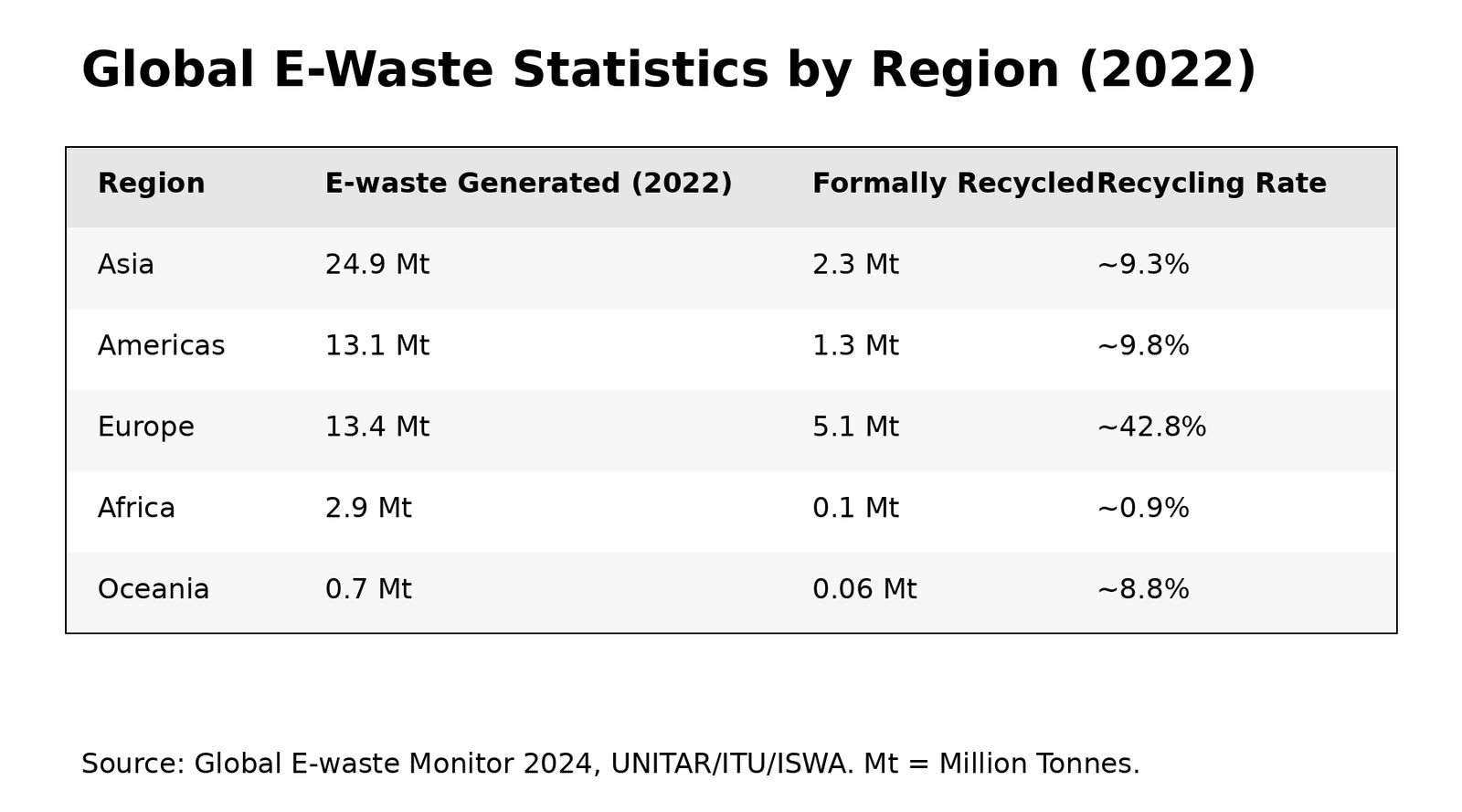
The Global E-waste Monitor 2024, published by the United Nations Institute for Training and Research (UNITAR), the International Telecommunication Union (ITU), and the International Solid Waste Association (ISWA), provides the most comprehensive data available on global e-waste trends.
62,000,000 tonnes of e-waste generated globally in 2022.
This figure represents an 82% increase from 2010, when 33.8 million tonnes were generated. If present trends continue, the annual volume will reach 82 million tonnes by 2030. Yet formal recycling capacity has not grown at the same rate. In 2022, only 13.8 million tonnes, equivalent to 22.3%, were formally collected and recycled through certified systems.
The remaining 48.2 million tonnes either accumulated in homes as unused stock, were disposed of in general waste streams, or were processed through informal and illegal channels. A significant portion of this informal processing occurs through cross-border shipments, where waste is moved from high-regulation environments to regions where enforcement is weaker and recycling costs are lower.
03 | Reason Behind Illegal E-Waste Recycling
Illegal e-waste recycling is not simply the result of bad actors operating in isolation. It is the product of structural failures across multiple systems, specifically regulatory systems, economic systems, and tracking systems. Understanding these drivers is essential for building effective responses.
1. Weak Tracking and Documentation Systems
The majority of e-waste generated in high-income countries lacks a traceable chain of custody after it leaves the point of collection. Once devices are placed in a recycling bin, donated to a collection drive, or handed to a local aggregator, there is often no verified system to confirm where they go next. Exporters exploit this gap by mislabeling shipments as second-hand goods or scrap metal, two categories that attract far less scrutiny from customs authorities.
In the 2025 Thailand Bangkok Port case, 238 tonnes of US-origin electronic waste arrived in 10 containers officially declared as mixed metal scrap. In the 2026 Laem Chabang case, 284 tonnes were declared as scrap metal from Haiti. Both were identified only through targeted risk profiling and intelligence from the Basel Action Network, not through routine documentation checks.
2. Insufficient Formal Recycling Capacity
The world currently lacks the formal recycling infrastructure to process the volume of e-waste being generated. Building certified e-waste processing facilities requires significant capital investment, trained personnel, environmental controls, and ongoing regulatory compliance. In many regions, particularly across parts of Asia and Africa, this capacity simply does not exist at the scale needed.
The result is that informal and illegal operators fill the gap. They can process materials faster and at a fraction of the cost precisely because they cut out the safeguards that responsible recyclers are required to maintain.
3. High Financial Incentives, Low Compliance Costs
E-waste contains substantial quantities of recoverable precious metals. One tonne of circuit boards can contain 15 to 400 times more gold than one tonne of gold ore. Silver, palladium, and copper add further value. For illegal operators who use open burning, acid leaching, and other unsafe methods to extract these materials, the profit margins are high because they bear none of the environmental or health costs their operations generate.
This creates an uneven playing field where certified recyclers, who comply with environmental regulations, cannot compete on price alone. The Malaysia 2026 crackdown seized e-waste and assets worth RM216 million across 140 raids, a figure that illustrates the financial scale of the illegal trade in that country alone.
4. Enforcement Gaps and Corruption
Even where laws exist, enforcement is inconsistent. Customs authorities in many countries lack the technical capacity to distinguish between legal second-hand goods exports and illegal e-waste shipments. Laboratory testing is required to confirm the hazardous nature of many materials, and this is not routinely conducted during standard customs inspections.
Corruption compounds the problem. In January 2026, Malaysia arrested the director-general and deputy director-general of its own Department of Environment as part of an investigation into corruption linked to e-waste management. The Malaysian Anti-Corruption Commission found that officials had allegedly abused their positions to facilitate illegal e-waste imports. This case illustrates that enforcement gaps in some instances are the result of deliberate institutional failure.
04 | The Problems Illegal E-Waste Recycling Creates
The consequences of unregulated e-waste processing extend across three distinct categories: environmental damage, public health risks, and data security breaches. These are documented outcomes of illegal operations that have been investigated and prosecuted globally.
Environmental Damage
When e-waste is processed without environmental controls, toxic substances leach directly into the surrounding ecosystem. Open burning of cables and circuit boards to extract copper releases dioxins, furans, and polycyclic aromatic hydrocarbons into the air. Acid baths used to strip gold from circuit boards generate acidic effluent that contaminates soil and groundwater.
Communities near illegal recycling sites in regions such as Agbogbloshie in Ghana and Guiyu in China have been extensively documented as suffering from heavily contaminated water sources and degraded agricultural land. These are the endpoints of the illegal trade.
Health Risks to Workers and Communities
Workers at illegal recycling sites, many of them children and young adults with no protective equipment, are exposed daily to lead, mercury, cadmium, beryllium, and brominated flame retardants. These substances are associated with neurological damage, kidney failure, respiratory disease, and increased cancer risk. Blood lead levels in children living near informal e-waste processing areas have been recorded at multiple times the safe threshold set by the World Health Organization.
In Thailand, investigations following the January 2025 factory bust found evidence that facilities were burning uncertified power supply units, releasing toxins into a densely populated province adjacent to Bangkok.
Data Security Risks
A frequently overlooked consequence of illegal e-waste handling is the data security exposure it creates. Devices that enter informal recycling channels often have not been properly data-wiped. Hard drives, smartphones, USB drives, and corporate servers contain sensitive personal information, financial records, login credentials, and in some cases government or military data.
Studies have repeatedly found that second-hand devices sourced from informal recycling markets in West Africa and South Asia contain recoverable data from previous users in Europe and North America. The India Operation DigiScrap seizure of October 2025 recovered 17,760 used laptops and 11,340 CPUs at Nhava Sheva Port, none of which had undergone certified data destruction. Every device represented a potential data breach.
05 | Global Enforcement: What Is Being Done
International institutions and national governments have responded to the growing scale of illegal e-waste trafficking with a combination of treaty obligations, enforcement operations, and policy reform. Progress has been made, though the enforcement community broadly agrees that it remains insufficient relative to the scale of the problem.
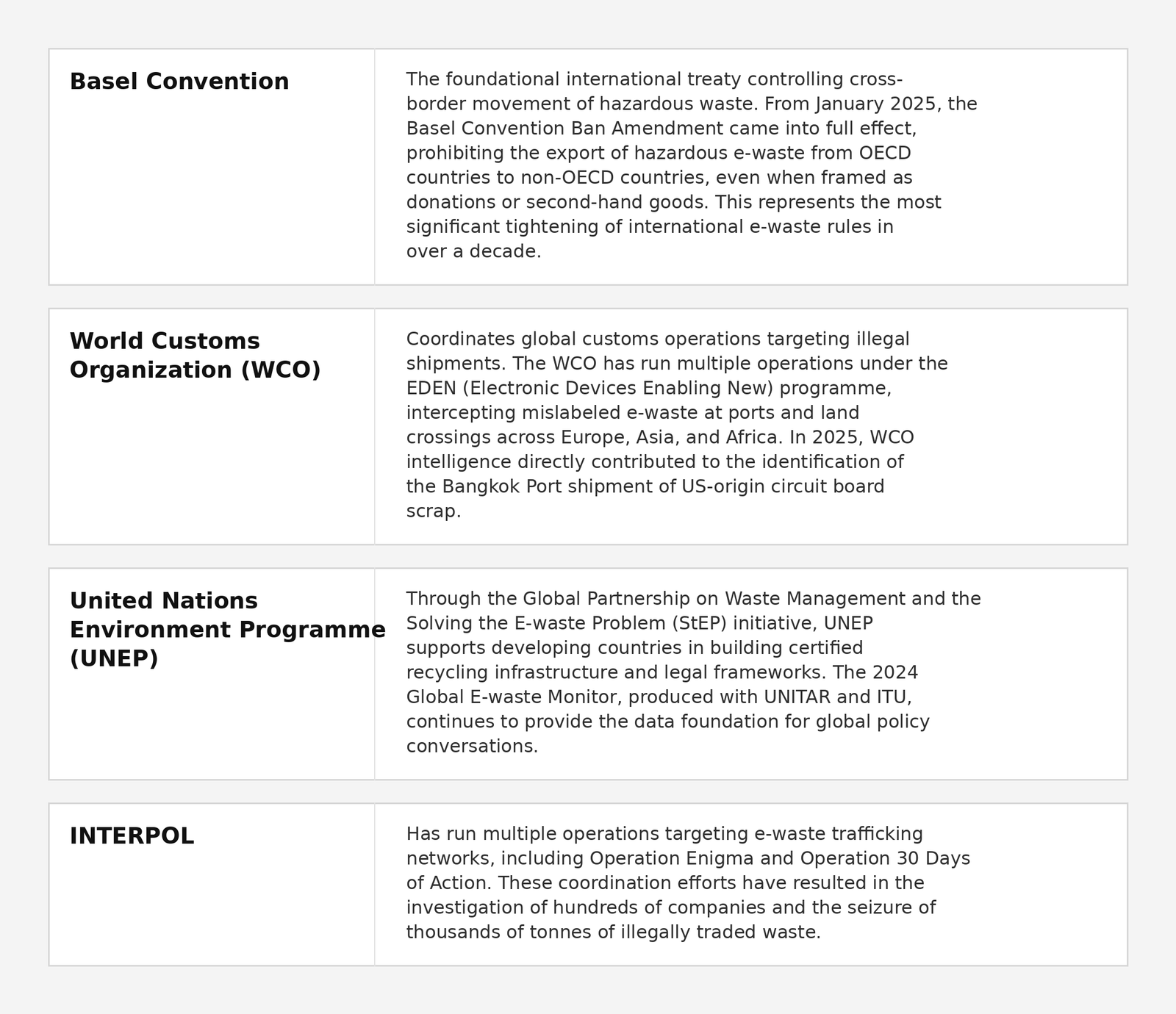
Global enforcement bodies and their role in tackling illegal e-waste trade
National-level actions have also intensified. Thailand expanded its e-waste import ban list from 428 to 463 prohibited categories in June 2025. Malaysia placed e-waste under the absolute prohibition category in February 2026, triggering a nationwide enforcement surge that resulted in 394 arrests. India's Directorate of Revenue Intelligence launched Operation DigiScrap in October 2025, targeting Nhava Sheva Port. These actions reflect a shift from passive regulation to active enforcement.
06 | Top 5 Cases Where Illegal E-Waste Was Caught
The following five cases have been selected based on verified enforcement data from government agencies, reputable news organisations, and international watchdog bodies. Each case is accompanied by confirmed figures and sourced references. They represent different categories of illegal e-waste activity: illegal processing facilities, port interceptions, smuggling networks, and corruption-linked operations.
CASE 1 | THAILAND (January 2025)
Seizure: Over 1,200 tonnes of e-waste seized at illegal factory
What Happened: Thai authorities from the Natural Resources and Environmental Crime Division (NRECD) raided CHH Recycle Company Limited in Bang Koh district, Samut Sakhon Province on January 5, 2025. The investigation began after two trucks were caught spilling e-waste in Prachinburi Province. The trail led authorities to a factory operating without proper permits, processing uncertified power supply units and other hazardous electronic components.
Outcome: The facility was ordered to cease operations immediately. Multiple charges were filed against operators, carrying potential prison terms and fines. :contentReference[oaicite:0]{index=0}
CASE 2 | THAILAND (2025–2026)
Seizure: 284 tonnes of e-waste seized at Laem Chabang Port
What Happened: Authorities intercepted shipments declared as scrap metal but containing processed circuit board scrap, violating import bans and Basel Convention norms. :contentReference[oaicite:1]{index=1}
Outcome: The shipment was ordered to be re-exported, and investigations into involved factories were initiated.
CASE 3 | INDIA (October 2025)
Seizure: Rs 23 crore worth of e-waste at Nhava Sheva Port
What Happened: Authorities uncovered 17,760 laptops, 11,340 CPUs, and other components hidden under scrap material, violating multiple regulations. :contentReference[oaicite:2]{index=2}
Outcome: A key suspect was arrested, and wider investigations into smuggling networks were launched.
CASE 4 | MALAYSIA (January–April 2026)
Seizure: 394 arrests and RM216 million in assets seized
What Happened: Nationwide raids targeted illegal recycling networks and uncovered large-scale operations involving foreign nationals. :contentReference[oaicite:3]{index=3}
Outcome: Major enforcement action led to arrests, policy tightening, and anti-corruption investigations.
CASE 5 | SPAIN (Europe–Africa Network)
Seizure: 5,000+ tonnes of e-waste smuggled
What Happened: A criminal network shipped hazardous waste disguised as second-hand goods to West Africa using forged documents. :contentReference[oaicite:4]{index=4}
Outcome: 43 suspects were arrested, and shipments were intercepted before export.
07 | How SND Recycler Upholds the Standard
The cases documented in this report are the direct competition that certified, responsible recyclers face every day. Illegal operators undercut market prices by avoiding the costs of proper processing, certified data destruction, employee safety, and environmental compliance. This creates pressure on the entire industry.
SND Recycler operates across four countries, each with its own regulatory framework and enforcement context. India's E-Waste (Management) Rules 2022 set strict requirements for extended producer responsibility and formal recycling channels. Malaysia's Department of Environment has licensed categories for scheduled waste processors. Germany operates under one of the world's most comprehensive WEEE directive implementations. Australia enforces the National Television and Computer Recycling Scheme (NTCRS) alongside the Product Stewardship Act.
SND Recycler Core Compliance Standards
- Certified data destruction with documented chain of custody for all processed devices
- No export of e-waste to non-compliant jurisdictions or informal processors
- Full traceability from collection point to end processing
- Compliance with Basel Convention obligations in all operating markets
- Regular third-party audits of processing facilities and downstream handlers
- Transparent reporting on recycling volumes, material recovery rates, and disposal methods
The growing number of enforcement actions globally is a signal that the informal sector is under increasing pressure. That gap can only be closed by scaling certified infrastructure, which is precisely the work that SND Recycler carries out across its operational footprint.
Companies that manage their e-waste through certified channels are actively reducing the volume available for illegal operators to exploit, protecting their own data security, and contributing to a supply chain where recoverable materials re-enter the formal economy rather than contaminating communities in developing nations.
08 | Conclusion
The five cases documented in this report, ranging from a 1,200-tonne illegal factory bust in Thailand to a 394-person arrest operation in Malaysia and a transnational criminal network running West Africa routes from Spain, are not outliers. They are representative samples of an enforcement landscape that is both escalating and still insufficient.
E-waste is the fastest-growing waste stream on the planet. The devices that societies discard every year contain both economic value and environmental hazard in the same circuit board. The question of where those devices go, and who processes them, is one of the defining industrial accountability issues of the current decade.
Governments are responding, with stricter legislation, expanded import bans, and high-profile enforcement operations. But the data is clear: at 22.3% formal recycling against a backdrop of 62 million tonnes generated annually, the formal sector is still far behind.
The Path Forward
- Stronger documentation and tracking requirements for all cross-border e-waste movements
- Expanded certified recycling capacity in countries currently served by informal networks
- Mandatory certified data destruction before any device enters the recycling stream
- Full implementation of the Basel Convention Ban Amendment across all signatory states
- Corporate accountability requirements for extended producer responsibility programs
09 | Sources
Sources
All data, case facts, statistics, and enforcement figures referenced in this report are drawn from the following verified sources. Publication dates are noted where available.
- [01] Global E-waste Monitor 2024
UNITAR, ITU, ISWA | https://ewastemonitor.info/gem-2024/ - [02] Trail of Debris Leads to 1,200-Ton E-Waste Seizure at Chinese Factory
Khaosod English | View Source - [03] Thai officials seize 238 tons of illegally imported US electronic waste
Washington Post / AP | View Source - [04] Thailand seizes 284 tonnes of illegal e-waste
The420.in | View Source - [05] Thailand Enforces Ban on Electronic Waste Imports
The Nation Thailand | View Source - [06] Operation DigiScrap: Rs 23 Crore E-Waste Shipment
Free Press Journal / India TV | View Source - [07] DRI Official Press Release
Government of India | View Source - [08] Malaysia E-Waste Crackdown (RM216 million seizures)
The Star Malaysia | View Source - [09] Malaysia arrests environment officials
Eco-Business | View Source - [10] MACC corruption case (DOE officials)
Scoop Malaysia | View Source - [11] Spain E-Waste Smuggling Network
OCCRP | View Source - [12] Spain busts smuggling group
France24 | View Source - [13] Malaysia intercepts illegal e-waste
Eco-Business | View Source - [14] Malaysia crackdown announcement
The Sun Malaysia | View Source - [15] Global crackdown on illegal waste networks
The Recycler | View Source - [16] EU e-waste exports report
Euronews / Basel Action Network | View Source - [17] INTERPOL Operation Enigma
INTERPOL | View Source - [18] Plastic waste trafficking research
Springer Nature | View Source
This report has been compiled for informational and awareness purposes by SND Recycler. All enforcement data reflects publicly available records at the time of publication (April 2026). SND Recycler is not responsible for any changes in case status subsequent to publication.
Electronic Waste Recycling
READY TO SPEAK WITH A RECYCLING SPECIALIST?
At S&D Recycler , we make it easy for organizations to do the RIGHT thing with their End of Life Electronic (EOL) IT Equipment. Honest, reliable & secure electronic waste recycling services.