
Lithium Battery Recycling Malaysia: Rules, Process & Where to Go
A Dead Battery Is Still Live
Most people bin a flat battery without a second thought. Under Malaysian law, it is classified as hazardous scheduled waste—and mishandled cells can start real fires.
This is a practical guide to lithium battery recycling in Malaysia, covering what the Department of Environment requires, how valuable materials are recovered, and where a battery should go instead of the bin.
What a Bad Cell Actually Does
Puncture, crush or overheat a lithium cell and it can enter thermal runaway—an internal chemical reaction that continues generating its own heat without requiring an external flame. It is why waste trucks and storage bins have caught fire because of a single crushed power bank sitting where it should not have been.
Never bin a lithium cell. When placed loose inside a rubbish bag or truck compactor, one damaged cell can be enough to ignite the waste around it.
There is a slower risk too: cobalt, nickel, manganese and electrolyte residue can leach into soil and groundwater when a battery is left in a landfill.
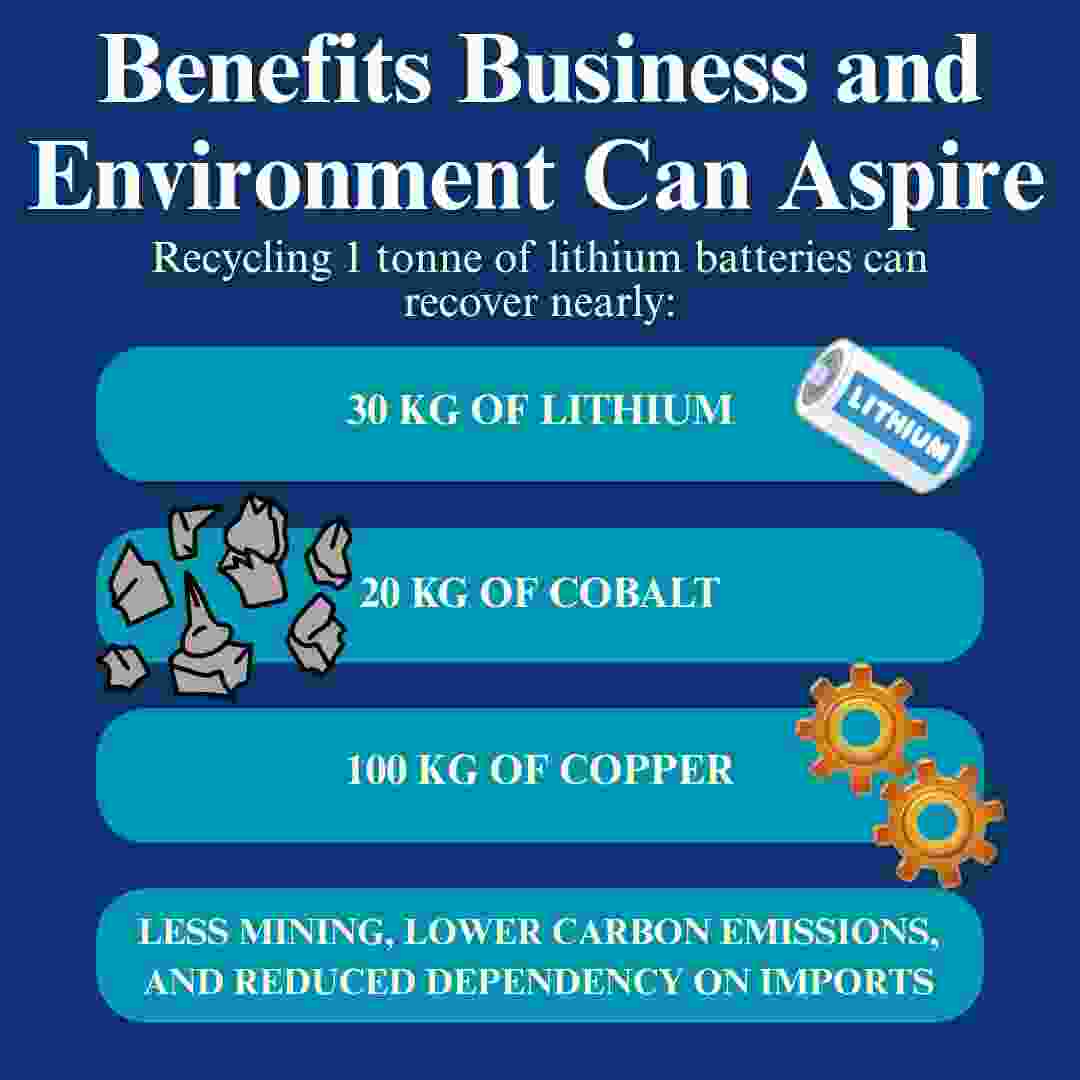
However, there is also an opportunity. That same battery contains recoverable metals. Global investment in lithium-ion battery recycling has reportedly exceeded US$8 billion since 2021, moving alongside the value of cobalt, nickel and lithium.
Sustainable battery disposal is not simply a compliance requirement. It determines whether valuable metals return to the manufacturing cycle or remain permanently lost in a landfill.
What the Law Actually Says
Battery disposal falls under the Environmental Quality (Scheduled Wastes) Regulations 2005 , enforced by Malaysia’s Department of Environment. Two waste codes are relevant: SW103 covers batteries containing cadmium, nickel, mercury or lithium, while SW110 covers broader e-waste, including batteries contained within larger electronic devices.
If your operation regularly produces battery waste, the DOE’s requirements are not optional:
- Register as a scheduled waste generator before disposing of battery waste.
- Store batteries in labelled, isolated containers and keep them separate from general waste.
- Transfer them only to DOE-licensed transporters and processing facilities.
- Record every movement through the e-SWIS reporting system.
This is not theoretical growth. The DOE expected Malaysia to generate 24.5 million units of e-waste in 2025 alone, while increasing EV adoption is adding to the challenge. EV registrations reportedly more than doubled year-on-year by April 2026.
A dedicated technical guideline for EV battery reuse and recovery is also being developed, alongside an Authorised Automotive Treatment Facility (AATF) framework for removing battery packs from end-of-life vehicles.
This growing demand is why lithium battery recycling operators in Malaysia are expanding their capacity, including SND Recycler’s Malaysia operations , which provide collection services across Kuala Lumpur, Penang and Shah Alam.
“E-waste is no longer allowed to enter the country. Enforcement must be carried out firmly, involving all agencies.”
Malaysian Anti-Corruption Commission, on tightened import controls
Where the Battery Actually Goes
Lithium-ion battery recycling follows a defined sequence. Each stage depends on the one before it, forming the backbone of the domestic e-waste recycling capacity Malaysia is now developing.
-
Intake and sort
Cells arrive from collection points or scheduled pickups and are immediately sorted according to their chemistry and physical condition.
-
Discharge
Any cell that still holds a charge is safely discharged before it goes near a dismantling line.
-
Dismantle
Battery packs are separated into cells, casings and circuitry so that each material stream can be processed appropriately.
-
Recover
Hydrometallurgical or pyrometallurgical processes extract “black mass”—a powder containing recoverable materials such as lithium, cobalt and nickel.
Malaysia now has domestic capacity for the final stage. The country’s first hydrometallurgical facility for integrated metal recovery operates as a closed system designed to meet DOE standards.
Which Door to Use
The correct disposal route depends on what type of battery you have and how much waste you generate:
Household – Phone, laptop and power-bank batteries: Take them to a licensed e-waste collection point or participating retailer. Household drop-off is generally available at no cost.
Household – E-scooter or e-bike battery packs (SW103): Use a retailer take-back programme or a licensed recycler. Never place these batteries in the general waste bin.
Business – Recurring battery or e-waste volumes: Register as a scheduled waste generator before arranging collection.
Business – EV battery packs (SW103): Route them through an Authorised Automotive Treatment Facility rather than a general recycling facility.
Paper trail worth keeping
For a business, "we disposed of it properly" only holds up with paperwork behind it, this is what separates compliant e-waste recycling Malaysia audits accept from battery disposal Malaysia regulators can penalise:
- Scheduled Waste consignment note under the DOE regulations
- e-SWIS movement record confirming a licensed transporter and processor
- Waste manifest with quantity, date, and disposal method
- Chain-of-custody trail from your premises to the processing facility
How collection works with us
SND Recycler runs licensed lithium battery recycling Malaysia businesses rely on for sustainable battery disposal, and we've built the process so your team doesn't have to think about it after the first call. See the full e-waste recycling service here.
- Scheduled pickup direct from your premises, no transport to arrange
- Every cell logged from pickup through to processing
- Consignment notes and disposal records issued by default, not on request
- Separate handling protocol for lithium specifically, run by trained staff
Correct disposal, documentation to prove it, none of the logistics on your plate. Arrange your first pickup here.
Before you ask us directly
Can I bin lithium batteries in Malaysia?
No, under lithium battery recycling Malaysia rules, they're classified as scheduled waste and must go through licensed collection. A punctured cell in a rubbish bag or truck is a genuine fire hazard, not a technicality.
Where's the nearest e-waste collection center Malaysia has?
Any DOE-licensed e-waste collection point or participating retailer works for household batteries. For scheduled business pickups, get in touch directly.
Does it cost anything?
Household drop-off is usually free, recyclers recover value from the metal itself. Business volumes may carry a collection or documentation fee depending on scope.
What if we skip proper disposal?
Unregistered generators or unlicensed handlers risk penalties under the Environmental Quality Act 1974, plus direct liability if a fire or spill follows.
Are EV batteries handled differently?
Yes, EV packs go through an Authorised Automotive Treatment Facility under SW103, separate from the general consumer e-waste stream.
How fast can a pickup happen?
Most collections are scheduled within a week of first contact once we know roughly what volume and battery type you're working with.
Electronic Waste Recycling
READY TO SPEAK WITH A RECYCLING SPECIALIST?
At S&D Recycler , we make it easy for organizations to do the RIGHT thing with their End of Life Electronic (EOL) IT Equipment. Honest, reliable & secure electronic waste recycling services.