
What Is E-Waste Material and Why Does It Need Proper Recycling?
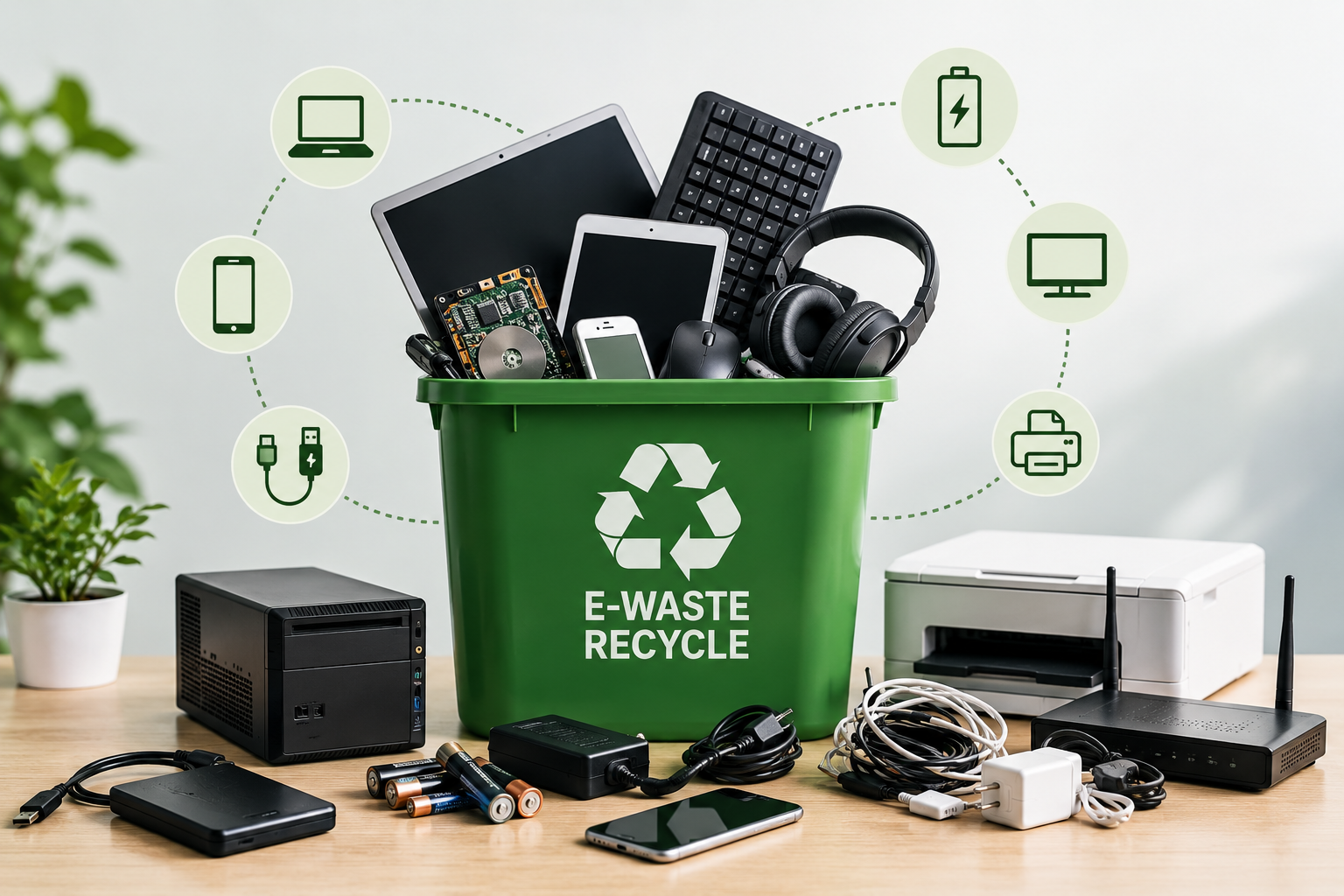
Table of Contents
- Introduction
- What Should Go Inside an E-Waste Recycle Bin? The Master List
- Computing and Office Equipment
- Mobile Devices and Communication Gadgets
- Display Devices and Televisions
- Printers, Scanners, and Imaging Equipment
- Batteries and Power Equipment
- Home and Kitchen Appliances
- Networking and Telecom Equipment
- Medical and Monitoring Devices
- Cables, Cords, and Accessories
- Storage Media and Data Devices
- What Should NOT Go Inside an E-Waste Recycle Bin?
- Tips for Businesses Managing Large Volumes of E-Waste
- Frequently Asked Questions
Every year, the world discards approximately 62 million metric tonnes of electronic waste, and that number is growing at a rate that alarms environmental scientists, policymakers, and sustainability advocates alike. Yet despite the scale of the problem, one of the most common questions that surfaces among individuals, office managers, and facility heads is deceptively simple: What Should Go Inside an E-Waste Recycle Bin?
It sounds like a basic question, but the answer has enormous consequences. Putting the wrong item into a recycle bin can contaminate an entire batch of recyclable material. Leaving the right item out means that it ends up in a landfill, leaching toxic substances like lead, mercury, cadmium, and brominated flame retardants into soil and groundwater.
At SND Recycler, India's trusted bulk e-waste management company, they handle thousands of tonnes of discarded electronics from corporates, institutions, hospitals, IT parks, and municipal bodies. The single biggest gap they identify in most businesses is that people simply do not know What Should Go Inside an E-Waste Recycle Bin and what should be kept out.
This blog post is designed to eliminate that confusion once and for all. Whether you are a sustainability officer at a large company, an office manager clearing out old hardware, or a homeowner doing a digital declutter, this guide gives you everything you need to know.
What Should Go Inside an E-Waste Recycle Bin? The Master List
The golden rule for understanding What Should Go Inside an E-Waste Recycle Bin is straightforward: if it has a plug, a battery, a circuit board, or runs on electricity, it almost certainly belongs there. However, the specific categories go broader and deeper than most people realise.
Here is a comprehensive breakdown.
1. Computing and Office Equipment
This is the most commonly recognised category when people think about What Should Go Inside an E-Waste Recycle Bin. Desktop computers, laptops, notebooks, and ultrabooks are the first items that come to mind, and rightly so. They contain circuit boards, processors, RAM modules, and hard disk drives that are rich in recoverable metals.
But the category extends beyond the obvious:
Desktop computers including the CPU tower, motherboard, RAM sticks, graphics cards, sound cards, and internal drives all qualify. Do not forget to include the power supply unit, heat sinks, and cooling fans.
Laptops and notebooks should go in whole, including their charging adapters and docking stations. The lithium-ion battery inside a laptop is itself a regulated harmful component that must never enter regular trash.
All-in-one computers like Apple iMacs or HP Eliteones contain built-in displays with LCD backlights that include mercury, making proper recycling especially critical.
Computer peripherals such as keyboards, mice (wired and wireless), webcams, external hard drives, USB hubs, and card readers also belong in the bin. Many people overlook these smaller items, but they add up in volume and contain recoverable copper and plastic.
Servers and workstations used in data centers and corporate IT setups qualify, and SND Recycler provides certified pickup services with data destruction documentation.
2. Mobile Devices and Communication Gadgets
Mobile devices are perhaps the fastest-growing subcategory in What Should Go Inside an E-Waste Recycle Bin, given how frequently consumers upgrade their smartphones. The average smartphone lifespan in India is now under two years, which means millions of units become waste annually.
Smartphones and feature phones of all brands belong in the e-waste recycle bin. A single smartphone contains over 60 elements from the periodic table, including gold, silver, cobalt, lithium, and rare earth elements like neodymium and dysprosium.
Tablets and e-readers contain lithium batteries and LCD displays, both of which require specialised processing.
Smartwatches and fitness trackers are increasingly common yet rarely deposited correctly. Their small size does not reduce their chemical complexity.
Cordless landline phones and their base stations qualify.
Walkie-talkies, two-way radios, and other handheld communication devices used in warehouses, security services, or field operations belong in the e-waste recycle bin.
Bluetooth headsets, earbuds (including AirPods), and wireless speakers all contain lithium batteries and should never go into regular bins.
3. Display Devices and Televisions
One of the most high-risk categories in the conversation about What Should Go Inside an E-Waste Recycle Bin involves display devices.
CRT (Cathode Ray Tube) televisions and monitors are the most dangerous type. Each CRT can contain between 2 to 7 kilograms of lead in the glass funnel alone. This is why CRT disposal is tightly regulated and why specialised recyclers like SND Recycler are equipped with the infrastructure to handle them safely.
LCD and LED televisions contain mercury in their fluorescent backlights (CCFL lamps), making them unsuitable for landfill.
OLED televisions and monitors are newer but still contain complex material stacks that require proper recycling.
Computer monitors of all types, whether CRT, LCD, or OLED, must go into the e-waste recycle bin.
Projectors used in offices, classrooms, and auditoriums contain mercury lamps and should be routed through a certified recycler.
Digital photo frames, smart displays, and electronic signage panels also qualify.
4. Printers, Scanners, and Imaging Equipment
Office environments generate significant e-waste through imaging equipment, yet this category is frequently overlooked in discussions of What Should Go Inside an E-Waste Recycle Bin.
Inkjet and laser printers contain circuit boards, rollers, and plastic casings that are all recyclable. Importantly, toner cartridges from laser printers and ink cartridges from inkjet printers should be collected separately for cartridge-specific recycling programs, though the printer body goes into the e-waste bin.
Multifunction devices (MFDs) that combine printing, scanning, copying, and faxing in a single unit qualify entirely.
Scanners and photocopiers used in offices are large, heavy items that bulk e-waste collectors like SND Recycler are specifically equipped to handle through scheduled pickups.
Fax machines, though increasingly rare, still appear in offices and belong in the e-waste recycle bin.
Label makers and barcode scanners used in retail, logistics, and warehousing also qualify.
5. Batteries and Power Equipment
Batteries deserve special attention in any guide on What Should Go Inside an E-Waste Recycle Bin because they combine high recycling value with serious environmental and fire hazards if mishandled.
Lithium-ion batteries from laptops, smartphones, tablets, and power banks are chemically reactive and can cause fires in compaction trucks if mixed with regular waste. They must go into designated e-waste or battery collection points.
Lead-acid batteries from cars, motorcycles, and UPS systems contain sulfuric acid and lead, both of which are classified as harmful waste. SND Recycler handles lead-acid batteries as part of its bulk collections from businesses with large UPS or data center setups.
Nickel-Cadmium (NiCd) batteries found in older power tools and cordless devices are highly toxic due to cadmium content.
Alkaline batteries from remote controls, clocks, and toys technically qualify as e-waste and should not go into general bins, though many municipal programs have separate collection points for them.
UPS (Uninterruptible Power Supply) systems from server rooms and offices contain large sealed lead-acid battery banks and should be disposed of through a certified bulk e-waste partner.
Solar panels from rooftop installations that have reached end-of-life also fall under e-waste regulations in India and should not be abandoned or sent to landfill.
6. Home and Kitchen Appliances
A frequently misunderstood area in the question of What Should Go Inside an E-Waste Recycle Bin involves household appliances. Many people separate electronics from appliances in their minds, but most modern appliances contain circuit boards and electronic components that classify them as e-waste.
Microwave ovens contain magnetrons, capacitors, and transformers that require safe handling. They belong in the e-waste recycle bin.
Electric kettles, coffee makers, toasters, and juicers all contain heating elements, thermostats, and wiring harnesses.
Electric fans, air coolers, and room heaters qualify, especially when their electronic speed controllers and timers are factored in.
Vacuum cleaners and robotic vacuums contain motors, circuit boards, and in the case of robotic models, lithium batteries.
Air conditioners and refrigerators are categorised as large household appliances and require special handling because of refrigerants like HFCs and HCFCs that are potent greenhouse gases. Certified recyclers like SND Recycler have the equipment and licensing to recover these gases before dismantling the unit.
Washing machines, dishwashers, and electric dryers contain electronic control panels and motors.
Electric water heaters and geysers with electronic thermostats and control units also qualify.
Note that gas-powered appliances without electronic components generally do not belong in the e-waste recycle bin and should be disposed of through appliance-specific channels.
7. Networking and Telecom Equipment
This category is especially relevant for businesses upgrading their IT infrastructure, and it represents one of the largest bulk volumes that SND Recycler processes from corporate clients.
Routers, modems, and Wi-Fi extenders from homes and offices belong in the e-waste recycle bin.
Network switches, hubs, and patch panels from corporate server rooms qualify.
Fiber optic equipment including ONU/ONT devices, media converters, and fiber patch panels contain electronic components that must be recycled properly.
CCTV cameras and DVR/NVR systems from security installations are growing categories of e-waste as institutes upgrade to higher-resolution systems.
Intercom systems, EPABX systems, and office telephone exchanges contain complex circuit boards and must be handled as e-waste.
Set-top boxes and cable modems from DTH and cable television subscriptions also qualify.
8. Medical and Monitoring Devices
An often-overlooked but critically important segment of What Should Go Inside an E-Waste Recycle Bin is medical and health monitoring equipment.
Blood pressure monitors, glucometers, pulse oximeters, and digital thermometers all qualify as e-waste at end-of-life.
Hearing aids are small but contain advanced microelectronics and tiny batteries that should not go to landfill.
ECG machines, CPAP devices, and portable oxygen concentrators contain sophisticated electronics and must be processed by certified recyclers.
Hospital diagnostic equipment such as infusion pumps, patient monitoring systems, and imaging accessories that have been decommissioned are regulated medical and electronic waste that requires dual compliance.
SND Recycler works with hospitals and healthcare facilities to ensure that decommissioned medical electronics are handled under both e-waste and biomedical waste protocols as applicable.
9. Cables, Cords, and Accessories
This is the most underestimated category of all when businesses ask What Should Go Inside an E-Waste Recycle Bin. Loose cables are often thrown into regular waste bins by offices during spring cleans, despite containing valuable copper and insulating plastics.
Power cables, extension cords, and surge protectors all belong in the e-waste recycle bin.
HDMI cables, VGA cables, USB cables, Ethernet cables, and audio-video cables qualify.
Chargers and power adapters for any electronic device, whether a phone, laptop, camera, or gaming console, must go into the bin.
Earphones, wired headphones, and microphones are recyclable e-waste items.
Remote controls for televisions, air conditioners, and home automation systems qualify due to their circuit boards and batteries.
Electronic toys and gaming accessories including controllers, handheld game consoles, VR headsets, and electronic educational toys all belong in the e-waste recycle bin.
10. Storage Media and Data Devices
Understanding What Should Go Inside an E-Waste Recycle Bin also requires knowing where data-carrying devices belong.
Hard disk drives (HDDs) and solid-state drives (SSDs) should always go through certified recyclers with documented data destruction processes. SND Recycler provides data destruction certificates that are essential for regulatory compliance, especially under India's DPDP Act (Digital Personal Data Protection Act, 2023).
USB flash drives, SD cards, and memory cards contain flash storage chips and metals.
DVDs, Blu-ray discs, and CDs in bulk quantities belong in e-waste collection, not regular paper recycling.
Optical disc drives from computers and gaming consoles qualify.
External hard drives and NAS (Network Attached Storage) devices contain platters, actuator arms, and circuit boards.
Tips for Businesses Managing Large Volumes of E-Waste
For corporate and institutional clients who regularly face the question of What Should Go Inside an E-Waste Recycle Bin, these practical strategies make compliance easier and more cost-effective.
Create a Dedicated E-Waste Collection Zone: Designate a secure storage area on your premises where end-of-life electronics accumulate between scheduled pickups. Label it clearly and restrict unauthorised access, especially since decommissioned storage devices present data security risks until they are formally destroyed.
Train Your IT and Facilities Teams: The people who decommission equipment should understand clearly What Should Go Inside an E-Waste Recycle Bin and what must be segregated separately. A short internal training session aligned with SND Recycler's intake guidelines prevents contamination and loss of recyclable material.
Maintain an Asset Register: Track all IT assets from purchase through decommissioning. This supports both financial asset management and regulatory compliance. SND Recycler can integrate with your asset register during pickup to ensure all items are accounted for.
Choose a Certified Partner: Not all recyclers hold valid authorisations from the State Pollution Control Board. Working with an unauthorised scrap dealer, however convenient, exposes your organisation to regulatory risk. SND Recycler holds all requisite certifications and provides the documentation that your compliance and CSR teams require.
Plan Around Hardware Refresh Cycles: Rather than disposing of old hardware sporadically, plan bulk pickups to coincide with hardware refresh cycles. This reduces per-unit handling costs and streamlines paperwork.
Do Not Forget Peripherals and Cables: During hardware refresh projects, industries frequently lose sight of what What Should Go Inside an E-Waste Recycle Bin means for smaller items. Every cable, adapter, keyboard, mouse, and external drive that accompanies the decommissioned hardware must be collected and handed over together.
Frequently Asked Questions
1. What Should Go Inside an E-Waste Recycle Bin in a typical home?
The short answer is that if it has a plug, a circuit board, or a battery, it goes into the e-waste recycle bin rather than the regular trash.
2. Can I put batteries in an e-waste recycle bin?
Yes, batteries are one of the most important items in the answer to What Should Go Inside an E-Waste Recycle Bin. Lithium-ion batteries, lead-acid batteries, and nickel-cadmium batteries all require specialised recycling and must not go into general waste.
3. Are broken electronics accepted in e-waste recycle bins?
The recycling value comes from the materials inside the device, and not from its functionality. Cracked smartphones, dead laptops, and damaged hard drives are all accepted.
4. Should I delete my data before recycling a device?
You should attempt to perform a factory reset on devices if they still function, but the more important step is ensuring that your recycler performs certified data destruction.
5. What is the difference between e-waste and regular waste?
Regular waste is material that can go into a municipal landfill without creating extraordinary environmental harm, such as food packaging, garden waste, or certain plastics. E-waste is any end-of-life product that runs on electricity or contains a battery, and it is classified as dangerous waste because of the toxic substances it contains.
Electronic Waste Recycling
READY TO SPEAK WITH A RECYCLING SPECIALIST?
At S&D Recycler , we make it easy for organizations to do the RIGHT thing with their End of Life Electronic (EOL) IT Equipment. Honest, reliable & secure electronic waste recycling services.