
What Is E-Waste Material and Why Does It Need Proper Recycling?
Every year, millions of smartphones are replaced. Offices retire ageing servers. Factories upgrade their machinery. Schools discard outdated computers. And in each of these moments, a critical question arises: where does all that old equipment actually go?
What Is E-Waste Material and Why Does It Need Proper Recycling?
This is one of the most pressing environmental and public health questions of our digital era. The answer affects human health, regulatory compliance, and the circular economy along with the nature that our planet urgently needs.
This guide is written for business owners, compliance officers, environmental managers, and anyone responsible for managing end-of-life electronics at scale. Whether you run a corporate office, a hospital, a school, or a manufacturing facility, understanding what is e-waste material and why does it need proper recycling is the first step toward responsible, compliant, and impactful action.
Table of Contents
- Understanding What Is E-Waste Material and Why Does It Need Proper Recycling
- Categories and Types of Electronic Waste
- Harmful Substances Hidden Inside Electronic Devices
- Valuable Resources Locked Inside E-Waste
- Environmental and Health Consequences of Improper Disposal
- Why Bulk E-Waste Management Is the Right Solution for Businesses
- Frequently Asked Questions
Understanding What Is E-Waste Material and Why Does It Need Proper Recycling
What Is E-Waste Material and Why Does It Need Proper Recycling? Let us start with the basics.
E-waste, or electronic waste, refers to any discarded electrical or electronic device or equipment that has reached the end of its useful life. This includes everything from desktop computers and laptops to televisions, refrigerators, air conditioners, washing machines, printers, mobile phones, batteries, and industrial machinery with electronic components.
The term "e-waste" is broad, and that breadth is exactly what makes it so challenging to manage. Unlike a piece of paper or a plastic bottle, a single laptop contains over 60 different elements from the periodic table, including precious metals, rare earth elements, and highly toxic substances. This complexity is precisely why understanding what is e-waste material and why does it need proper recycling goes far beyond simple trash disposal.
The United Nations defines e-waste under the category of Waste Electrical and Electronic Equipment (WEEE). According to the Global E-Waste Monitor 2024, the world generated approximately 62 million metric tonnes of e-waste in 2022, enough to fill 1.55 million 40-tonne trucks, which placed bumper to bumper would form a line long enough to circle the Earth more than 1.5 times.
What Is E-Waste Material and Why Does It Need Proper Recycling? The answer becomes significantly clearer when you realise that only 22.3% of that 62 million metric tonnes was formally documented as properly collected and recycled. The rest ended up in landfills, was informally processed, or was exported to developing countries, where it causes severe environmental and health damage that continues for generations.
Categories and Types of Electronic Waste
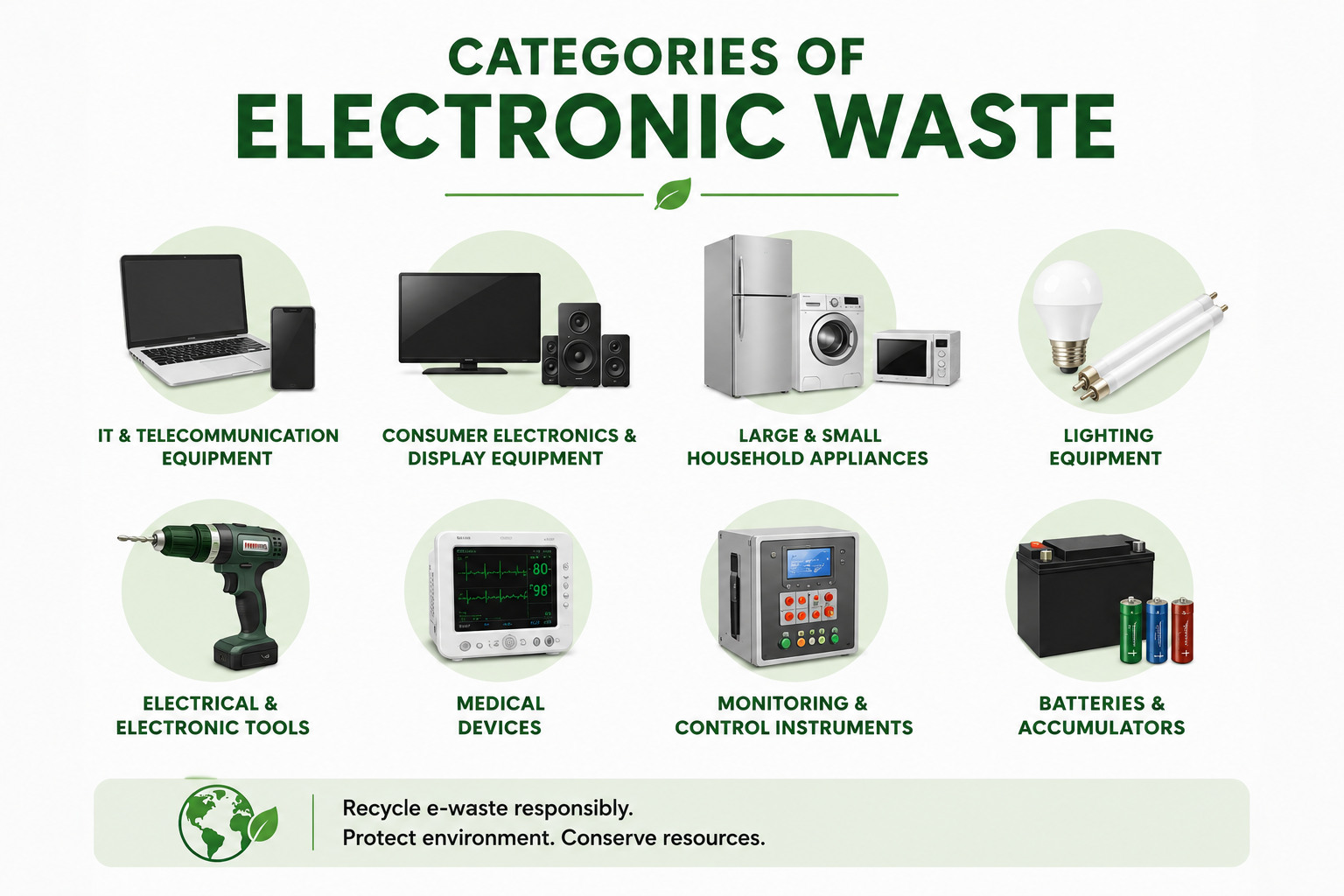
E-waste encompasses a wide spectrum of devices and equipment. Understanding what is e-waste material requires knowing what falls under this classification and why each category presents its own management challenges.
The key categories, as defined by India's E-Waste Management Rules and the international WEEE Directive, include the following:
Information Technology and Telecommunications Equipment
This category includes desktop computers, laptops, tablets, printers, photocopiers, mobile phones, telephone equipment, fax machines, and networking hardware such as routers, switches, and modems.
Consumer Electronics and Display Equipment
Televisions, monitors, projectors, audio equipment, video cameras, and DVD players all fall under this category. CRT (cathode ray tube) monitors and televisions are of particular concern due to their high lead content.
Large and Small Household Appliances
Refrigerators, air conditioners, washing machines, microwaves, electric stoves, and vacuum cleaners are considered large appliances. Small appliances include toasters, electric kettles, clocks, and electric shavers. Both categories contain electronic control boards and refrigerants that require specialised handling.
Lighting Equipment
Fluorescent lamps, LED lights, sodium discharge lamps, and other electronic lighting fixtures that contain electronic control components or high-risk substances like mercury.
Electrical and Electronic Tools
Drills, saws, sewing machines, lawn mowers, and industrial equipment with electronic components fall within this category.
Medical Devices
Electronic medical equipment such as MRI machines, ECG devices, dialysis machines, and diagnostic tools. Radioactive medical devices are generally excluded under most e-waste regulations and fall under separate dangerous waste frameworks.
Monitoring and Control Instruments
This includes smoke detectors, thermostats, laboratory instruments, and industrial control panels.
Batteries and Accumulators
Mobile batteries, industrial batteries, and lead-acid batteries from vehicles and uninterruptible power supplies (UPS) are among the most risky subcategories of e-waste.
Understanding these categories is fundamental to answering what is e-waste material and why does it need proper recycling, because each category carries its own profile of dangerous materials and its own set of recycling requirements.
Harmful Substances Hidden Inside Electronic Devices
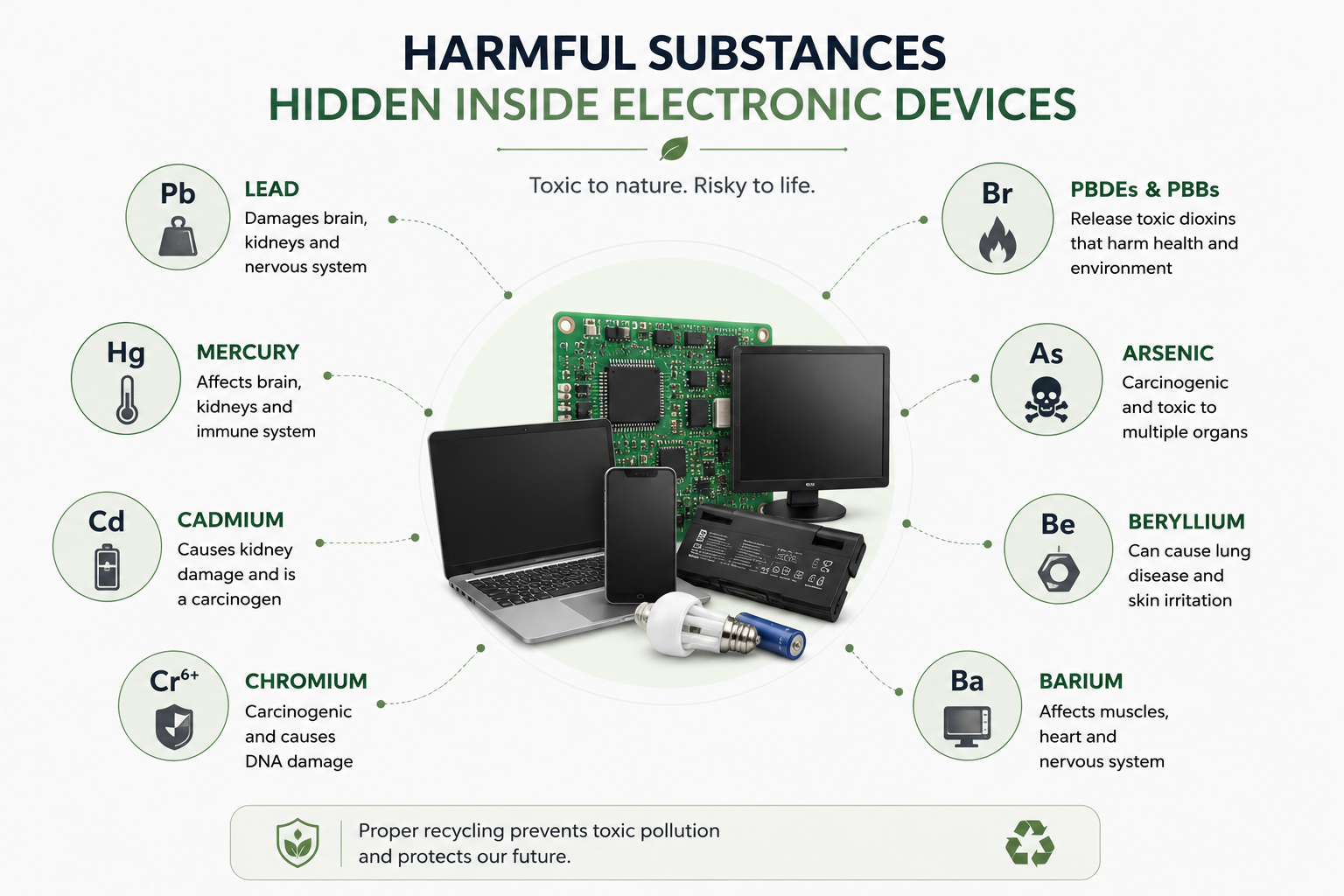
If you have ever wondered what is e-waste material and why does it need proper recycling at a chemical level, this section provides the clearest answer available.
Electronic devices contain a complex mixture of harmful substances. When improperly disposed of in landfills or incinerated, these substances leach into soil and groundwater or are released as toxic fumes into the air. The consequences are wide-ranging, long-lasting, and in many cases irreversible.
Lead (Pb)
Lead is found in CRT monitors, solder on printed circuit boards (PCBs), and older batteries. It is a potent neurotoxin that causes irreversible developmental damage in children and kidney damage in adults. A single CRT monitor can contain up to 8 pounds of lead. According to the World Health Organization (WHO), there is no known safe level of lead exposure in the human body.
Mercury (Hg)
Mercury is present in fluorescent backlights used in LCD screens and flat panel displays. It damages the nervous system, kidneys, and immune system. It is particularly high-risk when it vaporises during the open burning of e-waste, a common informal practice in many low-income regions.
Cadmium (Cd)
Found in rechargeable nickel-cadmium batteries and some older semiconductor components, cadmium is a recognised human carcinogen. It accumulates in the kidneys and liver over time and has a biological half-life of more than 30 years, meaning the body takes decades to eliminate even half of what it absorbs.
Hexavalent Chromium (Cr VI)
Used as a corrosion inhibitor in metal casings and components, hexavalent chromium is both carcinogenic and mutagenic, capable of causing DNA damage in exposed individuals.
Polybrominated Flame Retardants (PBDEs and PBBs)
These chemical compounds are added to circuit boards and plastic casings to reduce fire risk. However, when e-waste is burned, they release toxic dioxins and furans that persist in the environment for decades and accumulate in the food chain.
Arsenic and Beryllium
Arsenic is found in older semiconductor chips and has well-documented carcinogenic properties. Beryllium is used in contacts and connectors. Both are highly toxic in their elemental and compound forms.
Barium
Used in CRT displays, barium compounds can cause muscle weakness, swelling of the brain, and cardiac irregularities when absorbed through contaminated soil or water.
This toxic profile is one of the most direct and undeniable answers to what is e-waste material and why does it need proper recycling. Each of these substances, when handled without adequate equipment and containment protocols, poses direct risks to workers, local communities, and broader ecosystems.
Valuable Resources Locked Inside E-Waste
E-waste is simultaneously a significant resource. This dual nature is another critical dimension of understanding what is e-waste material and why does it need proper recycling, and it is the economic logic that makes responsible recycling financially sustainable.
Electronic devices contain significant quantities of precious and valuable metals that can be recovered and reintroduced into the manufacturing supply chain. A tonne of discarded mobile phones contains far more gold than a tonne of gold ore extracted from a mine.
Gold
Used in circuit board connectors and microprocessors for its excellent electrical conductivity and corrosion resistance. One tonne of e-waste contains approximately 200 to 300 grams of gold. By comparison, one tonne of gold ore from typical mining operations yields only 5 to 10 grams.
Silver
Used in solder, contacts, and circuit boards, silver is recoverable from most categories of electronic devices and has consistent high industrial demand across electronics and solar panel manufacturing.
Copper
Copper is used extensively in wiring, motors, heat sinks, and printed circuit boards. It is one of the most valuable and most readily recoverable materials in e-waste. A typical desktop computer contains approximately 600 grams of copper.
Palladium and Platinum
These rare metals are used in catalytic converters and specialised electronic contacts. They are extremely valuable on commodity markets and are becoming increasingly scarce in primary mining sources.
Aluminum and Steel
Used in device casings, frames, and chassis, these structural metals are highly recyclable and have a large secondary market across construction, packaging, and manufacturing industries.
Rare Earth Elements
Neodymium, praseodymium, and dysprosium are used in speakers, hard drives, and electric motors. These elements are also critical to green energy technologies, including wind turbines and electric vehicle motors, making their recovery from e-waste strategically important for the global energy transition.
When e-waste is recycled through a certified, responsible facility, all of these materials re-enter the supply chain. This reduces demand for virgin mining, which itself is one of the most environmentally destructive industrial activities on Earth. The resource recovery potential of e-waste is a compelling reason why what is e-waste material and why does it need proper recycling is a question that no industry operating at scale can afford to ignore.
Environmental and Health Consequences of Improper Disposal
To fully appreciate what is e-waste material and why does it need proper recycling, it is essential to examine in concrete terms what happens when electronic waste is not handled correctly.
Soil Contamination
When e-waste ends up in municipal landfills alongside regular household garbage, rainfall causes toxic metals including lead, cadmium, and mercury to leach into the surrounding soil. This contamination destroys agricultural land and persists for centuries, rendering soil unfit for food production or safe habitation.
Groundwater Pollution
Leachate from e-waste landfills contaminates groundwater aquifers, affecting drinking water sources for communities living near or downstream of disposal sites. Research published by Pure Earth and the Global Alliance on Health and Pollution has documented severely elevated heavy metal concentrations in water sources near informal e-waste processing zones in multiple countries across Asia and Africa.
Air Pollution from Open Burning
In many developing regions, informal recyclers resort to burning e-waste to recover metals quickly and cheaply. This releases a toxic mixture of dioxins, furans, and polycyclic aromatic hydrocarbons (PAHs), all of which are known to cause respiratory disease, cancer, neurological damage, and reproductive harm in exposed populations.
Health Impacts on Workers and Communities
Workers at informal e-waste processing sites are exposed to lead, mercury, cadmium, and other toxins through direct skin contact, inhalation of fumes, and ingestion from contaminated hands and food. Multiple independent studies have documented elevated blood lead levels in children living near informal e-waste recycling areas, with associated impacts on cognitive development and academic performance.
Ocean Pollution
A portion of informally processed or landfilled e-waste finds its way into river systems through surface runoff and ultimately enters the ocean, contributing to heavy metal contamination of marine ecosystems. This pollution enters the food chain through fish and shellfish consumed by human populations worldwide.
These documented consequences make it unambiguously clear why the question of what is e-waste material and why does it need proper recycling has real, measurable, and deeply serious consequences for communities, ecosystems, public health budgets, and the long-term sustainability of our shared environment.
Why Bulk E-Waste Management Is the Right Solution for Businesses
For businesses, hospitals, schools, government bodies, and large institutions, the answer to what is e-waste material and why does it need proper recycling ultimately points toward the need for a specialised, reliable, and fully authorised bulk e-waste management partner.
Bulk e-waste generators face challenges that individual consumers simply do not encounter. The volumes are substantially larger. The compliance requirements are more rigorous and more consequential. The data destruction obligations are more complex and legally significant. And the reputational stakes associated with mishandling are considerably higher.
The Benefits of Working with a Dedicated Bulk E-Waste Recycler
A dedicated bulk e-waste management company provides scheduled pickups calibrated to the organisation's asset retirement cycle, eliminating the logistical burden of storing large volumes of equipment on-premises. They offer certified data destruction with documented chain of custody and formal compliance certificates. They issue recycling certificates and comprehensive environmental reports that satisfy internal sustainability targets, ESG disclosures, and regulatory reporting requirements. They handle a full range of device types, from mobile phones and laptops to servers, networking equipment, UPS systems, air conditioners, and industrial electronics. And they ensure complete traceability of the recycling chain from initial collection through to final material recovery.
Choosing the right recycling partner means selecting a company that holds valid SPCB authorisation, is registered on the CPCB's EPR portal, is transparent about its downstream processing partnerships and material recovery outcomes, and is aligned with internationally recognised standards such as R2 (Responsible Recycling) or the e-Stewards Standard.
Businesses that make this choice move well beyond passive regulatory compliance and into active environmental leadership. They contribute meaningfully to the circular economy, protect their employees and surrounding communities from toxic exposure, reduce the demand for destructive primary mining, and position themselves as genuinely responsible corporate citizens.
FAQs
Frequently Asked Questions
1. What Is E-Waste Material and Why Does It Need Proper Recycling?
E-waste material refers to any discarded electrical or electronic device that has reached the end of its useful life, from phones and computers to refrigerators and industrial control panels. It needs proper recycling because it contains dangerous substances like lead, mercury, and cadmium that can severely damage soil, water, and air when disposed of incorrectly. At the same time, it contains genuinely valuable materials like gold, copper, silver, and rare earth elements that can be safely recovered and reused, reducing the environmental burden of primary mining while delivering economic value.
2. Is it illegal for businesses to throw e-waste in regular trash in India?
Yes, it is. Under India's E-Waste Management Rules, 2022, bulk consumers, including companies, hospitals, educational institutions, and government offices, are legally required to hand over end-of-life electronics only to authorised e-waste recyclers. Disposing of e-waste through regular municipal waste channels is a violation that can attract significant penalties under the Environment Protection Act, 1986.
3. What happens to the data stored on our old computers and hard drives?
A reputable bulk e-waste recycler will offer certified data destruction services before any physical processing begins. This typically involves degaussing, data overwriting to the required number of passes, or physical shredding of storage media, followed by the issuance of a formal Certificate of Data Destruction. This protects your organisation from potential data privacy liabilities and satisfies audit requirements.
4. What is EPR and why does it matter for our business?
EPR stands for Extended Producer Responsibility. Under India's E-Waste Management Rules, 2022, producers must collect and formally recycle a defined percentage of their historical sales volume as e-waste. When your business disposes of e-waste through a registered and authorised recycler, the recycler generates EPR certificates that producers can use to fulfil their legal collection targets. For your business, using an authorised recycler ensures you are part of a fully compliant, documented, and legally defensible recycling chain.
5. How often should a business schedule e-waste collection?
This depends on the size of the organisation and the pace at which equipment is retired. Smaller businesses may arrange for annual or semi-annual pickups. Large corporations, hospitals, and manufacturing facilities with high equipment turnover may require quarterly or even monthly collection schedules. A bulk e-waste management partner like SND Recycler can assess your specific asset retirement patterns and set up a customised, regular pickup plan at no additional logistics cost.
Electronic Waste Recycling
READY TO SPEAK WITH A RECYCLING SPECIALIST?
At S&D Recycler , we make it easy for organizations to do the RIGHT thing with their End of Life Electronic (EOL) IT Equipment. Honest, reliable & secure electronic waste recycling services.